Teen Patti Hand Probabilities: All 22,100 Deals
Six hand categories, exact combination counts and transparent assumptions. Understand how often each classic hand appears in a standard 52-card, three-card deal.
18+ only. Real-money games carry financial risk.
TeenPattiW · Updated
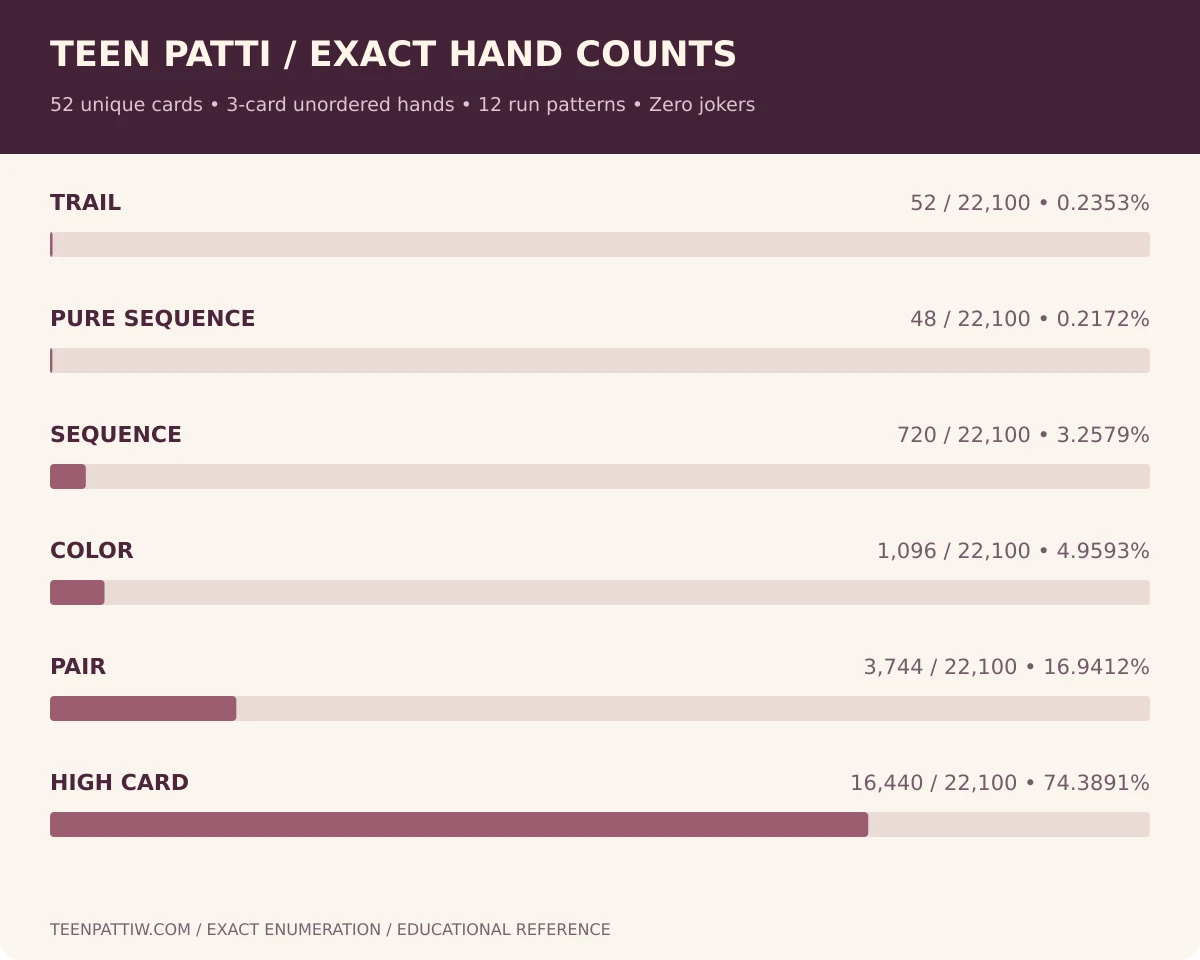
Exact Counts for Each Hand Category
Assumptions: one standard 52-card deck, three distinct cards, unordered hands, twelve recognised run patterns and zero jokers. Each combination belongs to exactly one category.
| ID | Category | Combinations | Probability | Counting rule |
|---|---|---|---|---|
| 1 | Trail / Trio | 52 | 0.2353% | 13 possible ranks × 4 ways to choose three of the four suits. |
| 2 | Pure Sequence | 48 | 0.2172% | 12 rank patterns × 4 suits. Each pattern stays entirely in one suit. |
| 3 | Sequence / Run | 720 | 3.2579% | 12 patterns × (4³ − 4). Count mixed-suit patterns separately from pure sequences. |
| 4 | Color / Flush | 1,096 | 4.9593% | 4 × C(13,3) − 48. The pure-sequence combinations are already in their own category. |
| 5 | Pair / Jodi | 3,744 | 16.9412% | 13 pair ranks × C(4,2) × 12 kicker ranks × 4 kicker suits. |
| 6 | High Card | 16,440 | 74.3891% | The remaining combinations after assigning Trail, Pure Sequence, Sequence, Color and Pair. |
Why the Total Is 22,100
Choose three distinct cards from a deck of 52, ignoring their dealt order: C(52,3) = 52 × 51 × 50 ÷ 6 = 22,100. Every category uses this same denominator.
Because card order is ignored, A♠ K♥ Q♦ and Q♦ A♠ K♥ are the same combination. Counting both would change the sample space.
How the Twelve Sequence Patterns Are Counted
The model includes A-2-3 and Q-K-A, plus the ten consecutive triples between them. Each pattern has 4³ suit assignments: four pure sequences and sixty mixed-suit sequences.
- 12 rank patterns × 4 same-suit assignments = 48 pure sequences.
- 12 rank patterns × 60 mixed-suit assignments = 720 sequences.
- 48 + 720 = 768 total consecutive-rank combinations.
Changing the priority of A-2-3 and A-K-Q changes their comparison order while preserving these counts, provided both remain recognised runs.
Rarity and Hand Priority Are Different Ideas
Pure Sequence occurs in 48 combinations and Trail in 52 under this model. Classic Teen Patti still places Trail above Pure Sequence. Category priority is a game rule; frequency is a count of possible deals.
Use the ranking list for priority and this page for mathematical frequency.
The Formulas Behind Color and Pair
A suit contains thirteen ranks, so it offers C(13,3) three-card choices. Across four suits there are 1,144 same-suit combinations; assigning 48 pure sequences to their own category leaves 1,096 Colors.
For a pair, choose its rank, choose two of its four suits, then choose a different kicker rank and one of that rank’s four suits: 13 × 6 × 12 × 4 = 3,744.
What Changes the Model?
Jokers, wild ranks, multiple decks and altered definitions create a different sample space. Recompute the categories whenever the set of eligible hands changes.
- A standard deck contributes 52 unique cards.
- Each counted hand contains exactly three distinct cards.
- Each recognised run uses three consecutive rank values.
- The six categories are assigned mutually exclusively.
- The category counts sum to the same 22,100-hand sample space.
Read Frequencies as a Learning Reference
These figures describe how many hands of each type exist in the stated model. An individual deal is one random outcome; repeated random deals can vary from the model’s long-run percentages.
For hand-to-hand comparisons, use the ranking and tie-breaker guides alongside this data.