Teen Patti Sequence List: Six Hands in Order
A complete classic hand-ranking reference, from Trail to High Card. Identify each pattern, read card examples and follow focused guides for ace rules and ties.
18+ only. Real-money games carry financial risk.
TeenPattiW · Updated
Start with the classic six categories, then check the specific conditions of any joker or low-hand variation. This page provides the main ranking reference for TeenPattiW.
Category first. Defining rank second. Kicker or remaining cards next. Table rule for a complete tie.
The Six Teen Patti Hands, in Order
Use this classic six-hand order as your starting point. Read any table-specific ace and joker rules before comparing individual hands.
| Rank | Hand | How to recognise it | Card example | Comparison rule |
|---|---|---|---|---|
| 1 | Trail / Trio | Three cards of one rank | A-A-A | Compare the repeated rank. A-A-A sits above K-K-K; 2-2-2 is the lowest trail. |
| 2 | Pure Sequence | Consecutive ranks in one suit | 8♥ 9♥ 10♥ | The suit and rank pattern work together. It sits immediately below Trail in classic ranking. |
| 3 | Sequence / Run | Consecutive ranks across mixed suits | 9♠ 10♥ J♦ | Use the table's sequence order. The consecutive ranks place this hand above Color. |
| 4 | Color / Flush | One suit with separate rank values | 3♥ 5♥ K♥ | Sort the cards high to low, then compare the first differing rank. |
| 5 | Pair / Jodi | Two matching ranks and a kicker | 9♠ 9♥ K♣ | Compare the pair first. For equal pairs, compare the remaining card, called the kicker. |
| 6 | High Card | Compare individual ranks, high to low | A♠ 7♣ 4♦ | Compare the highest card, then the second and third. Apply the table's rule for a complete tie. |
The Six-Hand Ranking Chart
Read the category name beside its card example. Start at Trail, then follow the list through the two sequence types, Color, Pair and High Card.
Save the compact rules chart as a PDF or image
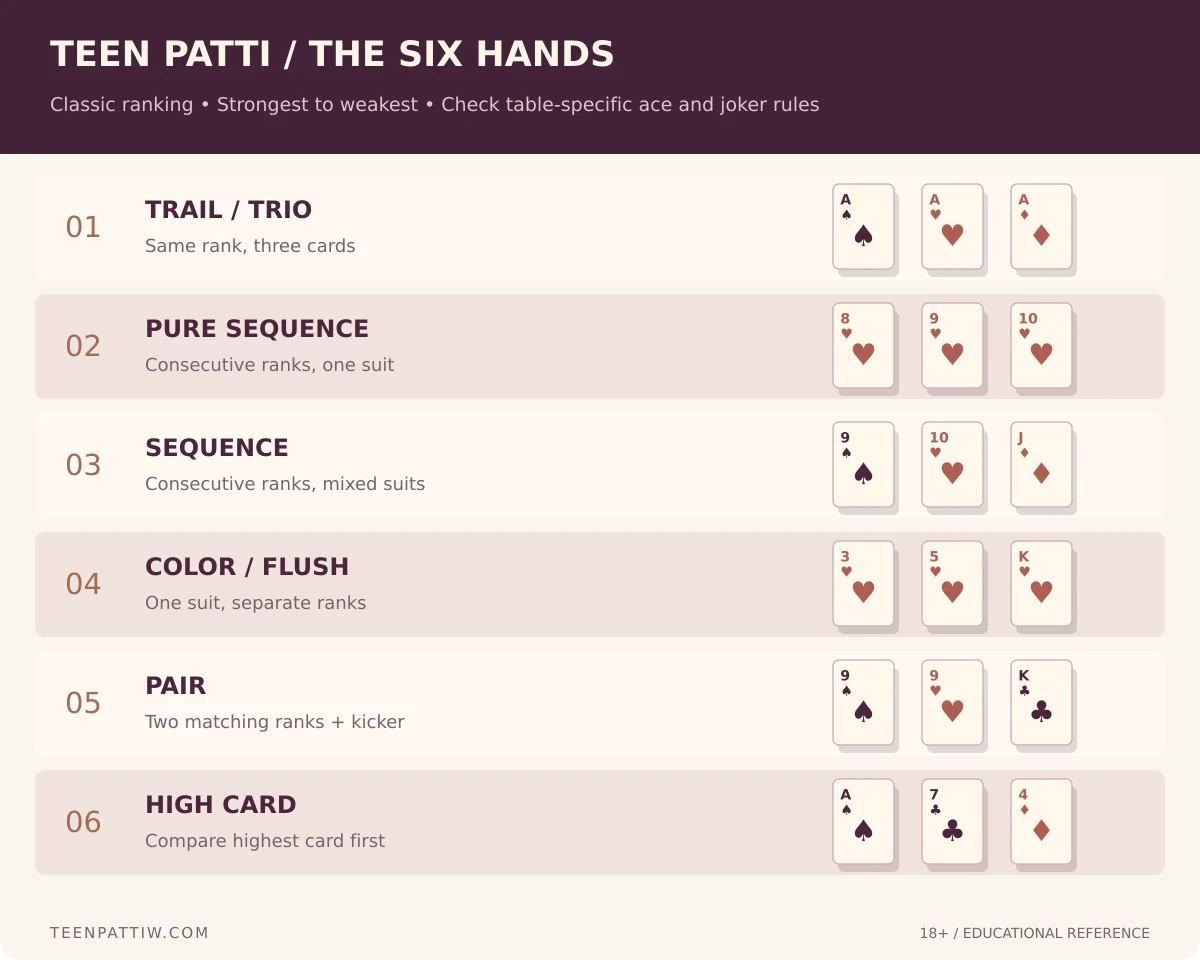
Identify Each of the Six Hand Types
Read each pair of hands, identify the deciding rank and apply the matching comparison rule.
| Rank | Hand | What decides it | Card example |
|---|---|---|---|
| 1 | Trail / Trio | Three cards of one rank | A-A-A |
| 2 | Pure Sequence | Consecutive ranks in one suit | 8♥ 9♥ 10♥ |
| 3 | Sequence / Run | Consecutive ranks across mixed suits | 9♠ 10♥ J♦ |
| 4 | Color / Flush | One suit with separate rank values | 3♥ 5♥ K♥ |
| 5 | Pair / Jodi | Two matching ranks and a kicker | 9♠ 9♥ K♣ |
| 6 | High Card | Compare individual ranks, high to low | A♠ 7♣ 4♦ |
How to Recognise a Pure Sequence
A pure sequence combines three consecutive ranks with one shared suit. 8♥ 9♥ 10♥ is a pure sequence; 8♥ 9♣ 10♦ is an ordinary sequence.
Check the ranks first, then the suits. This two-step check separates a pure sequence from an ordinary sequence or color.
A-K-Q and A-2-3: Read the Ace Rule
A-K-Q and A-2-3 are familiar sequence patterns. Their relative order depends on the table's ace convention. Some tables put A-K-Q first, while others give A-2-3 priority.
- Read the table's position for A-K-Q before comparing ace sequences.
- Confirm where A-2-3 sits in that same ordering.
- 2-3-4 is the usual lowest sequence pattern.
Agree on the ace convention at the start. One clear rule makes every later comparison simpler.
Trail or Sequence: Which Ranks Higher?
Trail leads the classic hand order, followed by Pure Sequence, Sequence, Color, Pair and High Card. A trail's three matching ranks place it above either kind of sequence.
Remember the middle of the list: Pure Sequence → Sequence → Color.
The Twelve Consecutive-Rank Patterns
With ace-low and ace-high patterns available, the twelve runs are A-2-3, 2-3-4, 3-4-5, 4-5-6, 5-6-7, 6-7-8, 7-8-9, 8-9-10, 9-10-J, 10-J-Q, J-Q-K and Q-K-A.
Each rank pattern can use one suit or mixed suits. That distinction determines Pure Sequence versus Sequence.
Comparing Two Hands of the Same Type
Start with the hand category. For equal categories, compare the ranks that define the hand: triplet rank, sequence order, pair rank or sorted individual cards. The table sets the result of a complete tie.
- Trail: compare the triplet rank, such as A-A-A against K-K-K.
- Sequence: compare the run using the table's ace convention.
- Color: compare the highest card, then the next differing card.
- Pair: compare the pair rank, followed by the kicker.
- High Card: compare all three sorted ranks in order.
Classic Rules and Table-Specific Variations
Teen Patti and 3 Patti are common names for the same three-card game. Joker, Muflis and other variations introduce their own comparison rules, so read each format's conditions separately.
Use the ranking list for the classic order, and the tie-breaker guide for close comparisons.
Questions answered
- What is the highest Teen Patti hand?
- Trail, also called Trio, leads the classic ranking. It contains three cards of one rank, with A-A-A the highest trail. Pure Sequence follows it.
- Where does A-2-3 fit in a sequence list?
- A-2-3 is a recognised run. Its place relative to A-K-Q follows the table's ace rule, so confirm that convention before comparing hands.
- How many rank patterns form a sequence?
- There are twelve consecutive-rank patterns when ace-low and ace-high runs are included. Suits create multiple card combinations within each pattern.
- Which hands rank above Color?
- Trail, Pure Sequence and Sequence all sit above Color in classic Teen Patti. Color uses one suit, with ranks that form a separate-rank pattern.
- Are Teen Patti and 3 Patti the same game?
- Yes. They are common names for the same three-card game. Individual variations and tables can apply their own additional rules.
- What separates Sequence from Pure Sequence?
- Both use consecutive ranks. Pure Sequence also uses one shared suit, giving it the higher classic category.