Teen Patti Rules Chart: A Saveable Reference
Three cards, classic hand order, blind and seen, turn order and show. Save a compact chart and use the full rules guide for context.
18+ only. Real-money games carry financial risk.
TeenPattiW · Updated
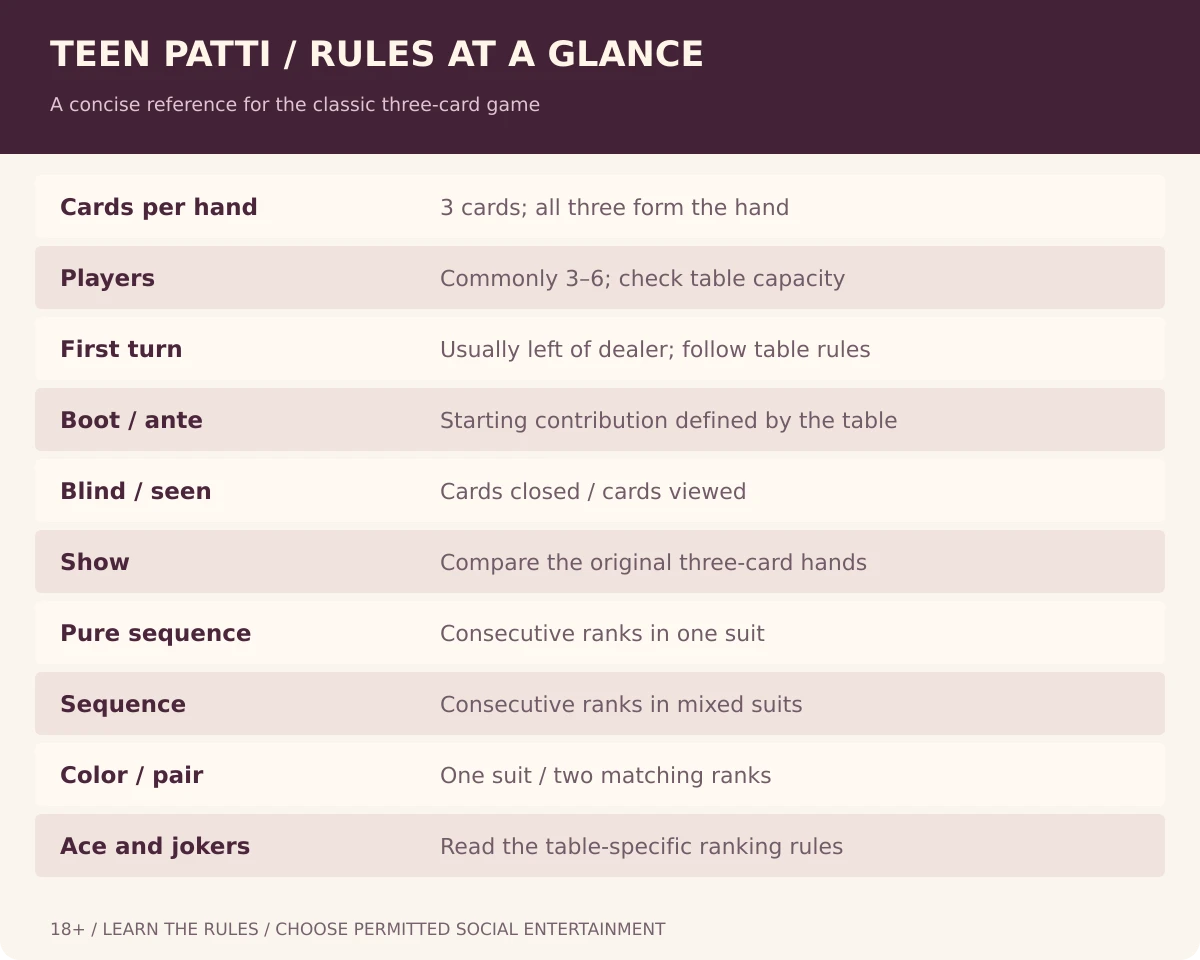
The Essential Teen Patti Rules in One Table
Each classic hand uses the original three cards dealt to the player. Turn order, initial contribution and comparison procedures follow the table's conditions. Read the ace and joker conventions separately.
| Rule | What to compare | What decides it |
|---|---|---|
| Cards per hand | 3 | Each player receives three cards, which form the complete hand. |
| Players at a table | Commonly 3–6 | Read the table's capacity and final-comparison conditions. |
| Opening action | Usually left of the dealer | Follow the table's defined starting position and clockwise order. |
| Opening boot / ante | Defined by the table | The rule sheet sets the starting contribution and procedure. |
| Show | Compare the original three cards | The original three dealt cards form each player's complete hand. |
| Pure Sequence | Consecutive ranks, one suit | Classic rank 2. Example: 8♥ 9♥ 10♥. |
| Sequence | Consecutive ranks, mixed suits | Classic rank 3, between Pure Sequence and Color. |
| Color | One suit, separate ranks | Classic rank 4. Example: 3♥ 5♥ K♥. |
| Pair | Two matching ranks and a kicker | Classic rank 5. Compare the pair, then the kicker. |
| High Card | Highest individual card first | Classic rank 6. Compare all three ranks in descending order. |
How to Recognise a Pure Sequence
A pure sequence shares one suit across three consecutive ranks, such as 6♠ 7♠ 8♠. Its category sits above Sequence and Color.
Check the ranks first, then the suits. This two-step check separates a pure sequence from an ordinary sequence or color.
A-K-Q and A-2-3: Read the Ace Rule
A-K-Q and A-2-3 are familiar sequence patterns. Their relative order depends on the table's ace convention. Some tables put A-K-Q first, while others give A-2-3 priority.
- Read the table's position for A-K-Q before comparing ace sequences.
- Confirm where A-2-3 sits in that same ordering.
- 2-3-4 is the usual lowest sequence pattern.
Questions answered
- What is the highest Teen Patti hand?
- Trail, also called Trio, leads the classic ranking. It contains three cards of one rank, with A-A-A the highest trail. Pure Sequence follows it.
- Where does A-2-3 fit in a sequence list?
- A-2-3 is a recognised run. Its place relative to A-K-Q follows the table's ace rule, so confirm that convention before comparing hands.
- How many rank patterns form a sequence?
- There are twelve consecutive-rank patterns when ace-low and ace-high runs are included. Suits create multiple card combinations within each pattern.
- Which hands rank above Color?
- Trail, Pure Sequence and Sequence all sit above Color in classic Teen Patti. Color uses one suit, with ranks that form a separate-rank pattern.
- Are Teen Patti and 3 Patti the same game?
- Yes. They are common names for the same three-card game. Individual variations and tables can apply their own additional rules.
- What separates Sequence from Pure Sequence?
- Both use consecutive ranks. Pure Sequence also uses one shared suit, giving it the higher classic category.