A-K-Q vs A-2-3: Understand Teen Patti Ace Order
The ace can connect a low run or a high run. Learn the recognised patterns and the table convention that decides their relative position.
18+ only. Real-money games carry financial risk.
TeenPattiW · Updated
Six Ace and Sequence Checks
Use the same category definitions for each hand, then read the table’s ace priority. These six checks separate a rank pattern from its position in the rules.
| Check | Pattern | Identity | Example | What to read |
|---|---|---|---|---|
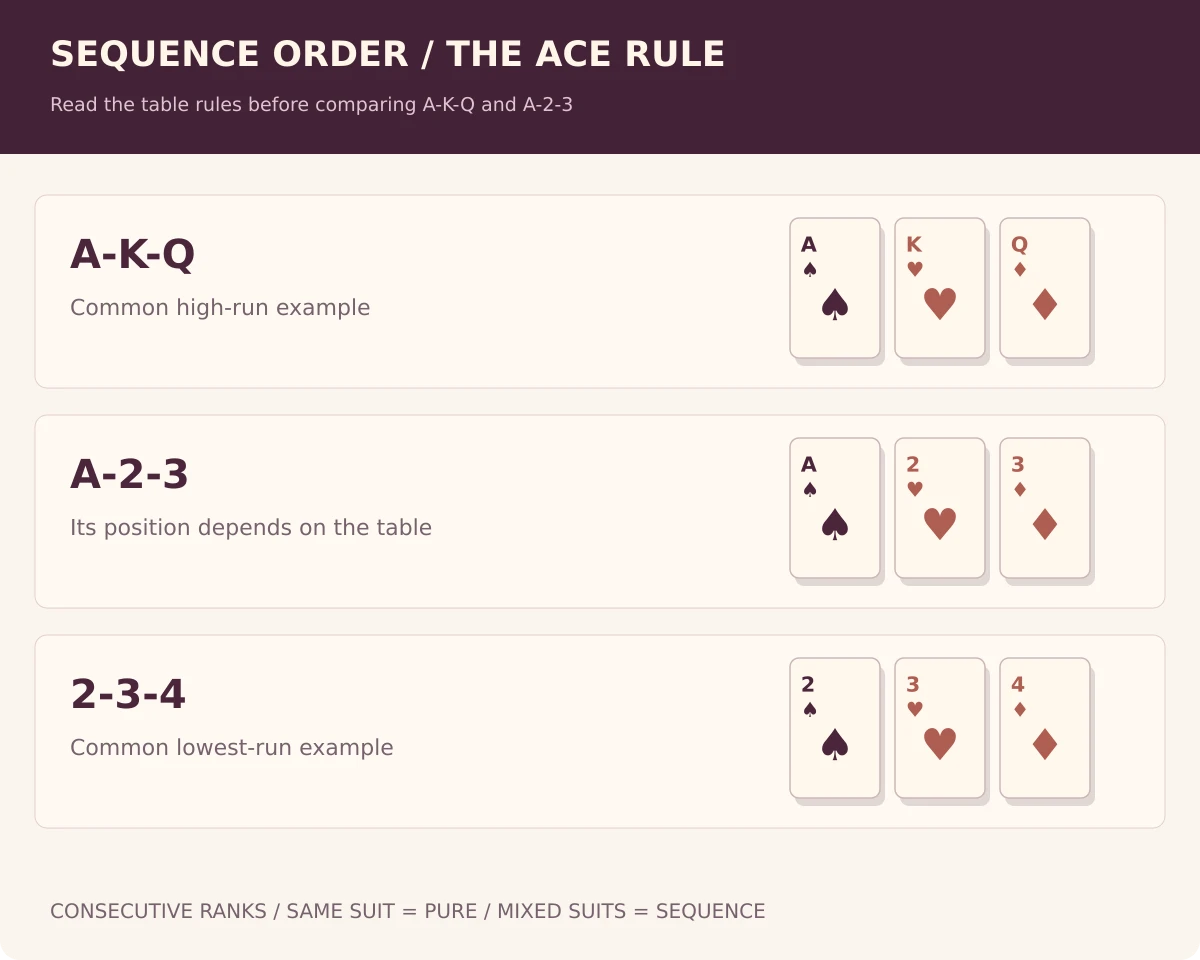
| 1 | A-K-Q | Ace at the high end | A♠ K♥ Q♦ | A recognised run. Compare its position with A-2-3 using the table convention. |
| 2 | A-2-3 | Ace at the low end | A♠ 2♥ 3♦ | A recognised run. Some conventions place it first and others give A-K-Q priority. |
| 3 | K-Q-J | Consecutive high ranks | K♠ Q♥ J♦ | Compare its run position with the other recognised sequences. |
| 4 | 2-3-4 | Consecutive low ranks | 2♠ 3♥ 4♦ | The usual lowest run under common ace-high and ace-low conventions. |
| 5 | K-A-2 | Wrap-around rank pattern | K♠ A♥ 2♦ | Read this mixed-suit example as High Card under standard consecutive-rank definitions. |
| 6 | One suit or mixed suits | Category check | A♠ K♠ Q♠ | One shared suit makes a recognised run Pure Sequence; mixed suits make it Sequence. |
Ace-High and Ace-Low Are Two Separate Patterns
An ace can complete Q-K-A at the high end or A-2-3 at the low end. Each pattern uses three adjacent rank positions within its convention.
Check the three ranks as one complete pattern rather than moving the ace through the middle of an arbitrary group.
A-K-Q and A-2-3: Read the Ace Rule
A-K-Q and A-2-3 are familiar sequence patterns. Their relative order depends on the table's ace convention. Some tables put A-K-Q first, while others give A-2-3 priority.
- Read the table's position for A-K-Q before comparing ace sequences.
- Confirm where A-2-3 sits in that same ordering.
- 2-3-4 is the usual lowest sequence pattern.
Agree on the ace convention at the start. One clear rule makes every later comparison simpler.
Apply Category Priority Before Ace Priority
A pure sequence and an ordinary sequence belong to different categories. The pure sequence has category priority. Compare run positions only after both hands share the same sequence category.
Category first. Run order second. Complete-tie convention last.
List the Twelve Recognised Patterns
The twelve patterns are A-2-3, 2-3-4, 3-4-5, 4-5-6, 5-6-7, 6-7-8, 7-8-9, 8-9-10, 9-10-J, 10-J-Q, J-Q-K and Q-K-A.
This is a list of eligible patterns. The table’s ace rule supplies their comparison order.
Comparing Equal Run Ranks
When both sequences share the same run ranks, consult the table’s rule for a complete tie. Use the same procedure consistently for the relevant show or sideshow.
- Identify the category of each hand.
- Confirm that both use recognised run patterns.
- Apply the agreed sequence ordering.
- Check for equal run ranks.
- Apply the table’s complete-tie procedure when needed.
Make the Ace Convention Explicit
A brief rule-sheet statement resolves the central question: which comes first, A-2-3 or A-K-Q? Keep that convention visible alongside the ordinary category list.
Explore the tie-breaker reference for the next step after run positions match.