Teen Patti Tie-Breakers: Compare Equal Hands
Two hands share a category. What happens next? Compare pairs, colors, high cards and sequences with clear examples and an agreed table rule.
18+ only. Real-money games carry financial risk.
TeenPattiW · Updated
A hand category settles the first comparison. When both hands share that category, use its specific tie-break rule and check every relevant card.
Category first. Defining rank second. Kicker or remaining cards next. Table rule for a complete tie.
A Quick Comparison Order for Equal Hands
The deciding detail changes with the hand. A pair needs a kicker check; a color needs a sorted three-card comparison.
| Case | Category | First check | Two example hands | Deciding detail |
|---|---|---|---|---|
| 1 | Trail | Triplet rank | A-A-A / K-K-K | A-A-A has the higher triplet rank. |
| 2 | Pure Sequence | Run position | 8♠ 9♠ 10♠ / 7♥ 8♥ 9♥ | 8-9-10 is the higher ordinary run. |
| 3 | Sequence | Agreed ace convention | A-K-Q / A-2-3 | Use the table’s declared ace order. |
| 4 | Color | Sorted card ranks | A♥ 9♥ 5♥ / A♠ 8♠ 7♠ | The second card decides: 9 above 8. |
| 5 | Pair | Pair rank, then kicker | 9♠ 9♥ K♣ / 9♦ 9♣ Q♥ | The pairs match; the king kicker is higher. |
| 6 | High Card | Sorted card ranks | A♠ 9♥ 5♦ / A♥ 9♣ 4♠ | The third card decides: 5 above 4. |
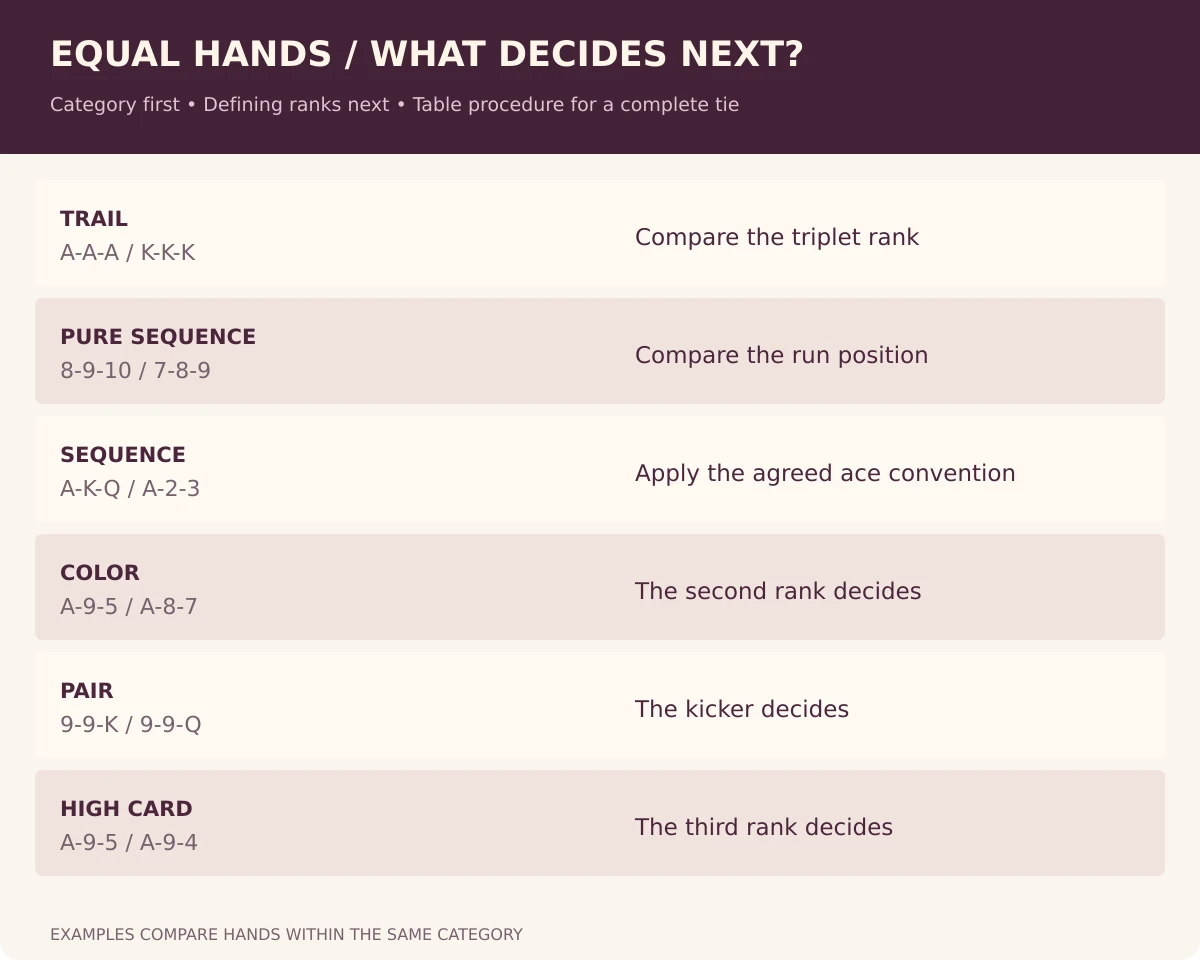
The Tie-Breaker Reference Chart
Use this visual comparison order to see which card matters next. Start at the category, then follow the appropriate row.
Six Worked Hand Comparisons
Read each pair of hands, identify the deciding rank and apply the matching comparison rule.
| Case | Category | Compare | Two example hands |
|---|---|---|---|
| 1 | Trail | Triplet rank | A-A-A / K-K-K |
| 2 | Pure Sequence | Run position | 8♠ 9♠ 10♠ / 7♥ 8♥ 9♥ |
| 3 | Sequence | Agreed ace convention | A-K-Q / A-2-3 |
| 4 | Color | Sorted card ranks | A♥ 9♥ 5♥ / A♠ 8♠ 7♠ |
| 5 | Pair | Pair rank, then kicker | 9♠ 9♥ K♣ / 9♦ 9♣ Q♥ |
| 6 | High Card | Sorted card ranks | A♠ 9♥ 5♦ / A♥ 9♣ 4♠ |
When Two Pure Sequences Meet
Both hands already share a category. Compare their run positions using the same ace convention. For example, 8-9-10 sits above 7-8-9 under ordinary ascending run order.
Suits define the pure-sequence category. Apply the table’s complete-tie rule when the run ranks also match.
Tie-Breaking an Ace Sequence
A-K-Q versus A-2-3 requires the table’s ace convention. Establish that convention once, then apply it equally to both pure and ordinary sequences.
- Use one agreed order for both hands.
- Read A-2-3 in its assigned position.
- A complete match in run ranks reaches the table’s tie rule.
The ace-sequence guide compares the conventions in detail.
Different Categories Settle Before Kickers
Category priority comes first. A Pair sits above High Card even when the high-card hand contains an ace. Kicker comparison applies after establishing that both hands contain the same pair rank.
First category, then defining rank, then the remaining cards.
Pair Rank First, Kicker Second
Compare 9♠ 9♥ K♣ with 9♦ 9♣ Q♥: both pairs are nines, so K beats Q as the kicker. Against 10♠ 10♥ 2♣, the pair of tens has priority because pair rank is the first comparison.
The third card decides only after the pair ranks match.
Colors and High Cards: Compare All Three Ranks
Sort each hand from high to low. A-9-5 beats A-8-7 at the second card. A-9-5 beats A-9-4 at the third. Use the same descending-rank procedure for equal colors and for equal high-card categories.
- Compare the highest rank in each hand.
- For equal top cards, compare the second rank.
- For equal first and second cards, compare the third.
- For equal three-rank patterns, read the complete-tie procedure.
- Use suit priority only when the table expressly defines it.
What a Complete Tie Means
A complete tie has equal relevant ranks after every category-specific comparison. The table’s show or sideshow procedure then defines the result. Keep that procedural rule distinct from hand strength.
For the complete classic category order, use the main sequence-list reference.
Questions answered
- How do equal pairs compare?
- Compare the pair rank first. For matching pairs, compare the kicker. A complete match reaches the table’s tie procedure.
- Do suits decide an equal hand?
- Read the table’s explicit suit and complete-tie conventions. Category rules alone establish the first part of a comparison.
- How do two colors compare?
- Sort both hands high to low. Compare the first rank, then the second, then the third until a difference appears.
- Does a pair beat an ace-high hand?
- Yes. Pair is the higher category in the classic order. Individual ranks are compared after both hands share a category.
- What happens with identical rank patterns?
- Use the table’s complete-tie procedure for the relevant show or sideshow. That procedural decision is separate from category priority.
- How are two ace sequences compared?
- Apply the same agreed ace convention to both hands. The ace-order guide explains the common alternatives.