Pure Sequence vs Sequence vs Color: See the Difference
Start with two questions: are the ranks consecutive, and do the suits match? These examples make the three hands easy to tell apart.
18+ only. Real-money games carry financial risk.
TeenPattiW · Updated
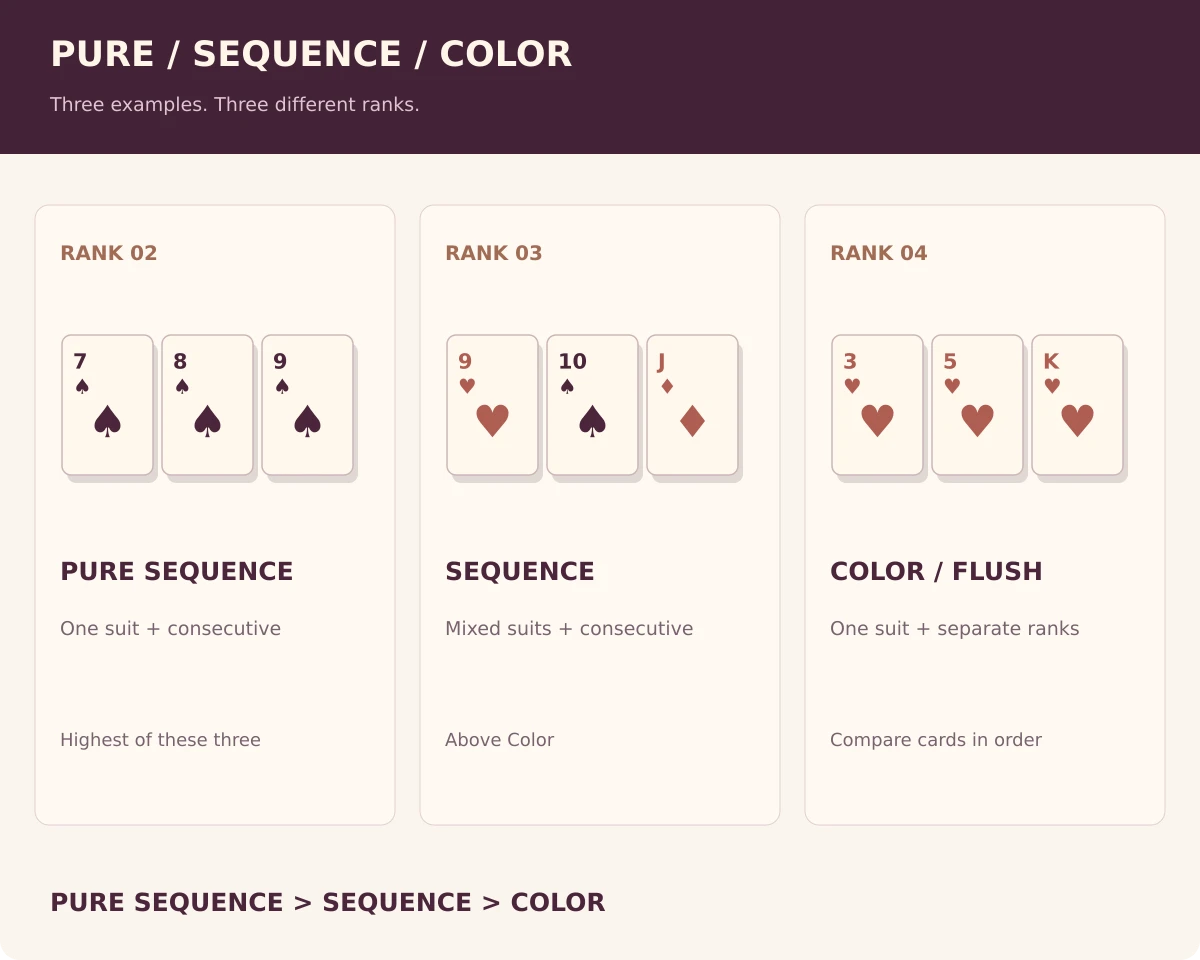
Six Comparisons That Make the Difference Clear
Read the category from the pattern. Then compare categories in the classic order before checking individual card values.
| Check | Feature | Look for | Example | Result |
|---|---|---|---|---|
| 1 | Pure Sequence | Consecutive ranks + one suit | 7♠ 8♠ 9♠ | Both conditions are present, so the hand is Pure Sequence. |
| 2 | Sequence | Consecutive ranks + mixed suits | 9♥ 10♠ J♦ | The ranks form a run and the suits are mixed, so the category is Sequence. |
| 3 | Color | One suit + separate ranks | 3♥ 5♥ K♥ | The shared suit defines Color after the run check has been resolved. |
| 4 | Pure vs Sequence | Different categories | 7♠ 8♠ 9♠ vs 9♥ 10♠ J♦ | Pure Sequence has category priority, even when the ordinary run uses higher ranks. |
| 5 | Sequence vs Color | Different categories | 2♠ 3♥ 4♦ vs A♥ K♥ J♥ | Sequence has category priority over Color. |
| 6 | Color vs Color | Same category | A♥ 9♥ 5♥ vs A♠ 8♠ 7♠ | The top cards match, so the second card decides: 9 above 8. |
One Suit and Consecutive Ranks: Pure Sequence
7♠ 8♠ 9♠ passes both checks: the ranks are consecutive and the suit stays the same. That combination defines Pure Sequence.
Check the run and suit separately; each contributes a different part of the category definition.
A-K-Q and A-2-3: Read the Ace Rule
A-K-Q and A-2-3 are familiar sequence patterns. Their relative order depends on the table's ace convention. Some tables put A-K-Q first, while others give A-2-3 priority.
- Read the table's position for A-K-Q before comparing ace sequences.
- Confirm where A-2-3 sits in that same ordering.
- 2-3-4 is the usual lowest sequence pattern.
Agree on the ace convention at the start. One clear rule makes every later comparison simpler.
A Lower Run Can Beat a Higher Color
A 2-3-4 Sequence sits above an A-K-J Color because category priority is decided first. High individual cards become relevant when both hands share the same category.
Compare the type of hand before comparing its individual values.
Use a Two-Question Identification Routine
First ask whether the three ranks form a recognised run. Then ask whether all three suits match. A run plus one suit is Pure Sequence; a mixed-suit run is Sequence; a separate-rank one-suit hand is Color.
Apply the table’s ace convention when checking A-2-3 and A-K-Q.
Tie-Breaking Within These Categories
Compare run positions for two pure sequences or two ordinary sequences. For two colors, compare the sorted highest card, then the second and third. A full rank match reaches the table’s tie procedure.
- Pure Sequence: compare the run positions.
- Sequence: compare the same table-defined run order.
- Color: compare all three sorted ranks.
- Ace patterns: use the agreed ace convention.
- Complete rank matches: read the table’s procedure.
Keep the Table Rules Beside the Examples
Classic category priority is the starting point. Joker rules, ace priority and a complete-tie procedure belong to the specific format you are reading.
Use the tie-breaker guide when both hands pass the same category check.